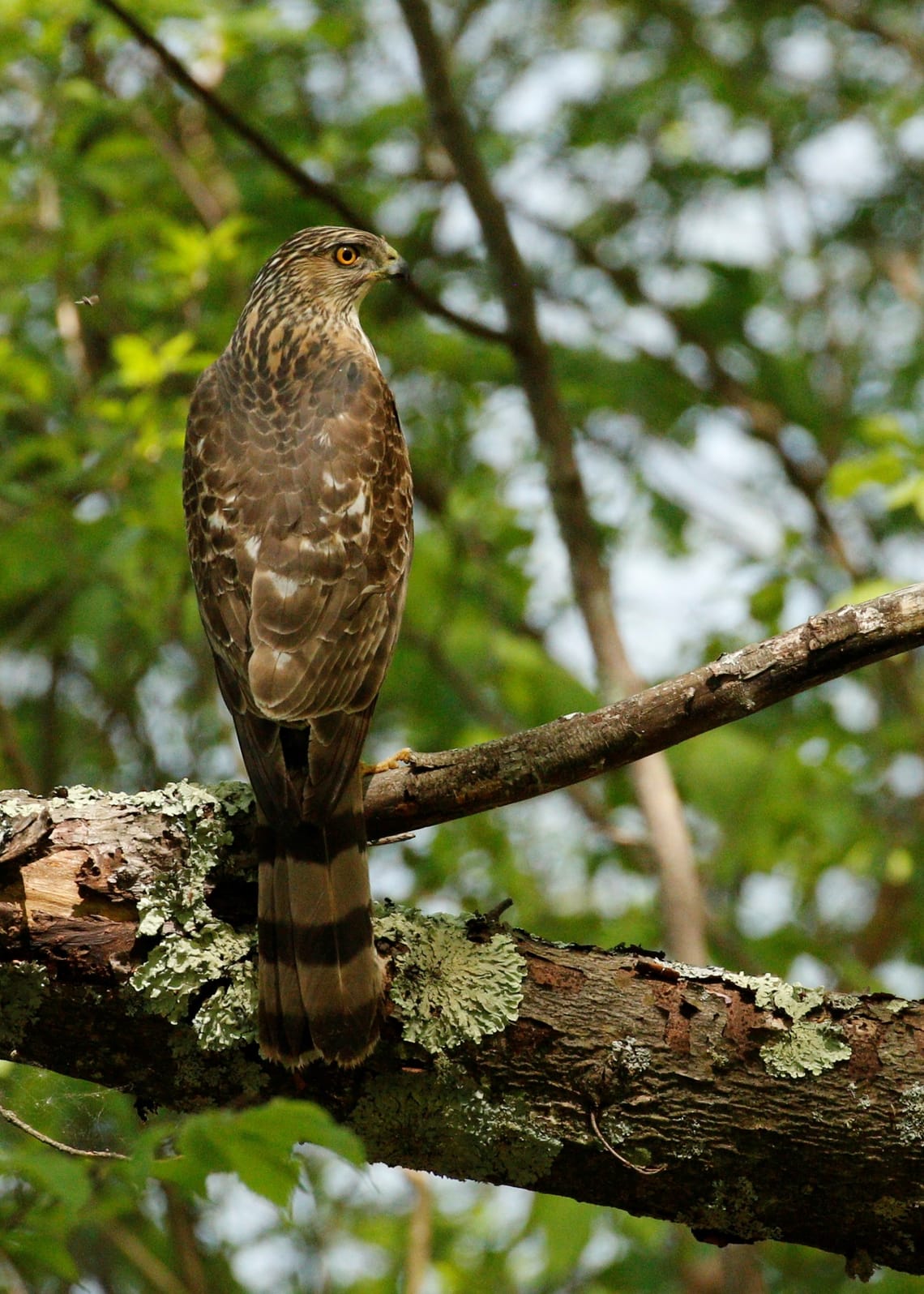
Cooper's Hawk: The Backyard Predator
That explosion of feathers on your lawn tells a story. The suddenly silent bird feeder, the flash of brown through the trees, the scattered remains of what was once a mourning dove - a Cooper's Hawk has paid your yard a visit.
The Suburban Success Story
Fifty years ago, seeing a Cooper's Hawk in a suburban backyard would have been extraordinary. DDT and habitat loss had devastated their populations. Today, they're thriving in neighborhoods across North America, and there's one simple reason: we accidentally built them the perfect habitat.
Our suburbs, with their mix of trees and open spaces, mimic the forest edges Cooper's Hawks love. Better yet, we've stocked these areas with bird feeders that concentrate their prey in predictable locations. For a Cooper's Hawk, a busy feeder station isn't a restaurant - it's a buffet where the food comes to you.
This adaptation has been so successful that Cooper's Hawks are now more common in many suburban areas than in their traditional forest habitats. They've learned to navigate fence lines, hunt along hedgerows, and even perch on deck railings while scanning for unwary songbirds.
The Identification Challenge
"Is it a Cooper's or a Sharp-shinned?"
This question has frustrated birders for generations. These two accipiters (forest hawks) look remarkably similar, and size isn't reliable - a female Sharp-shinned can be nearly as large as a male Cooper's. Here's what actually works:
Head shape: Cooper's Hawks have a blocky, squared-off head with a dark cap. Sharp-shinneds have rounded heads that look small for their body.
Tail tip: Cooper's have rounded tail tips with a white terminal band. Sharp-shinneds have square-cut tails, like someone trimmed them with scissors.
Neck: Cooper's Hawks have a longer neck, creating a "hunched forward" look when perched. Sharp-shinneds appear more compact.
Leg thickness: If you can see them, Cooper's Hawks have legs about as thick as a pencil. Sharp-shinned legs are matchstick thin.
Still confused? You're in good company. Even experienced birders sometimes have to let one go as "accipiter species."
Built for the Chase
Everything about a Cooper's Hawk is designed for high-speed pursuit through dense vegetation. Their long tail acts as a rudder, allowing instant direction changes. Those long legs? They're for reaching out and snatching prey mid-flight. The relatively short, rounded wings provide explosive acceleration and the ability to thread through impossibly tight spaces.
Watch a Cooper's Hawk hunt and you'll see something remarkable: they can fly at full speed through a maze of branches that would stop other birds cold. They've been clocked at over 30 mph through dense forest, making split-second adjustments that seem to defy physics.
Their eyes, positioned more forward than most hawks, give them the binocular vision needed to judge distances precisely during these high-speed chases. One miscalculation at that speed could be fatal.
The Backyard Dilemma
Here's the uncomfortable truth: if you feed birds, you're occasionally going to feed them TO birds. Cooper's Hawks are simply part of the ecosystem, whether that ecosystem is wild forest or suburban backyard.
Finding a pile of cardinal feathers can be distressing, but consider this: Cooper's Hawks typically take the slowest, weakest, or least alert birds. They're inadvertently strengthening the gene pool of their prey species. That cardinal at your feeder who always seems to spot danger first? Its alertness might be partly thanks to generations of Cooper's Hawk pressure.
Some people remove their feeders after a hawk attack. This is unnecessary - Cooper's Hawks have territories and hunting routes whether feeders exist or not. Your feeder didn't cause the predation; it just made it visible.
Living with the Hunter
If a Cooper's Hawk has discovered your feeder, it will likely return periodically. Most develop a routine, visiting at roughly the same time each day. The songbirds know this too - watch for the sudden silence and empty feeder that signals a hawk's presence even before you see it.
Want to minimize predation? Consider these approaches:
- Place feeders near dense shrubs where small birds can escape
- Avoid ground feeding during peak hawk activity
- Keep feeders closer to windows (counterintuitively, this reduces strike speed)
- Accept that some predation is natural and even necessary
The Bigger Picture
That Cooper's Hawk perched in your yard, scanning for prey with those intense orange eyes, represents one of conservation's success stories. From near extinction to suburban success, they've shown remarkable adaptability.
Yes, they eat songbirds. They also eat house sparrows, starlings, and other non-native species. They control rodent populations. They're part of the complex web that keeps ecosystems - even suburban ones - functioning.
The next time you see that distinctive long-tailed silhouette or find those telling feathers on your lawn, take a moment to appreciate what you're witnessing: a perfectly evolved predator that's learned to thrive in the world we've created.
Observing Cooper's Hawks regularly? Consider participating in Project FeederWatch or eBird to help scientists track their suburban expansion.