The Prehistoric Presence of Great Blue Herons
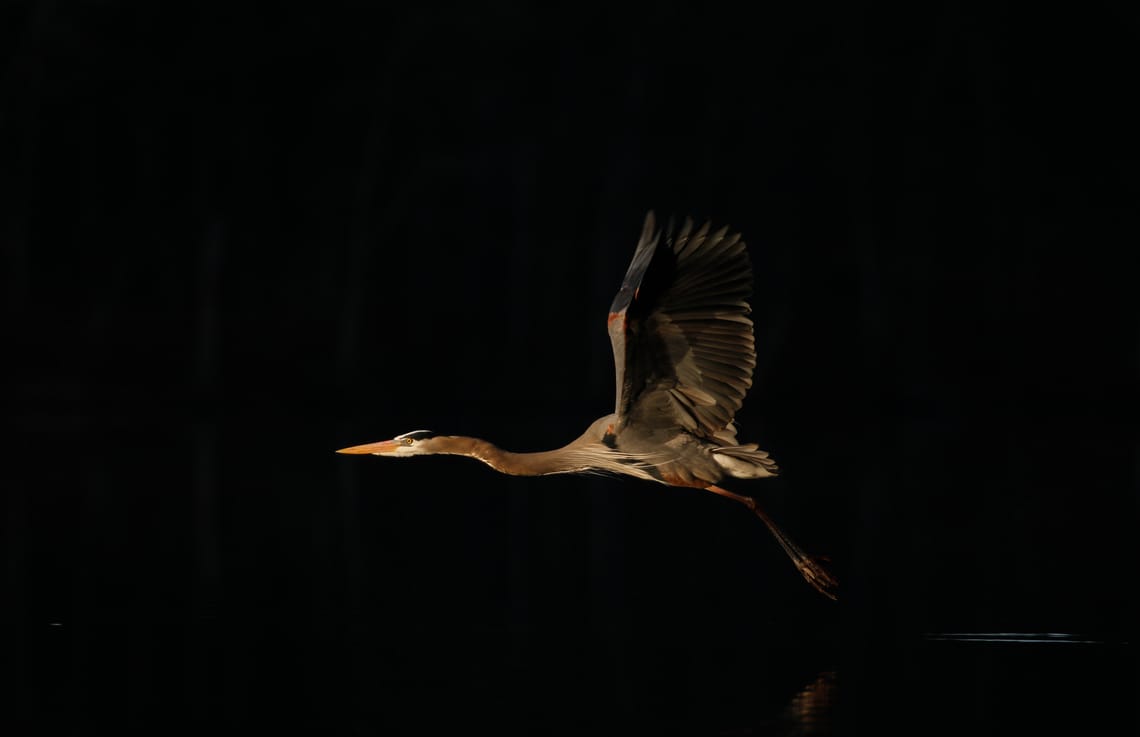
When a Great Blue Heron unfolds its six-foot wingspan and launches into flight, you're not just watching a bird. You're witnessing a body design that has survived since the age of dinosaurs, a living link to the prehistoric world that once dominated our planet.
The Sound of Ancient Times
If you've ever heard a Great Blue Heron's call, you know it's unlike any typical bird sound. That harsh, guttural croak - somewhere between a bark and a prehistoric screech - seems pulled from a primordial swamp. It's the kind of sound that makes you understand, viscerally, that birds didn't descend from dinosaurs. Birds ARE dinosaurs.
This isn't poetic license. Modern science has confirmed what that primitive call suggests: birds are the only surviving lineage of theropod dinosaurs. And few birds wear their dinosaur heritage as obviously as the Great Blue Heron.
Architecture of the Ages
Look at a Great Blue Heron's skeleton and you're essentially looking at a blueprint that has remained unchanged for millions of years. Those impossibly long legs? They're the same basic design as their ancient relatives who stalked through Cretaceous swamps. The S-curved neck contains specially modified vertebrae that allow it to strike with the speed of a spring-loaded spear - a fishing technique perfected long before humans existed.
Even their feet tell an ancient story. What looks like a backward-bending knee is actually their ankle, lifted high off the ground. Their actual knee is hidden up near their body. It's the same arrangement dinosaurs used, optimized for wading and striking.
Perhaps most remarkable are their powder down feathers - specialized feathers that continuously grow and disintegrate into a fine powder. This primitive feature, shared with only a few other bird groups, helps waterproof their plumage. It's a solution to staying dry that predates modern feather oils by millions of years.
The Patience of Geological Time
Watch a Great Blue Heron hunt and you're observing a strategy older than most mountain ranges. They can stand motionless for an hour, waiting for the perfect moment to strike. This isn't learned behavior - it's encoded in their DNA, a hunting method so successful it has outlasted ice ages, mass extinctions, and the rise and fall of countless other species.
When they do strike, it happens faster than human eyes can properly track - about 200 milliseconds from decision to impact. Their specialized neck vertebrae create a harpoon-like thrust that ancient fishing pterosaurs would recognize. The prey never sees it coming, just as fish haven't seen it coming for millions of years.
Flying Through Time
In flight, Great Blue Herons become even more obviously prehistoric. That slow, measured wingbeat - about two beats per second - moves them through the air at 20 to 30 miles per hour with an economy of motion that speaks to eons of refinement. Unlike cranes, which fly with necks extended, herons retract their necks into an S-curve, improving aerodynamics and balance.
Watching their silhouette against the sky, wings spanning wider than most humans are tall, it's impossible not to think of pteranodons or other flying reptiles. The comparison isn't far off - both evolved similar solutions to the same problem of being large, flying predators.
Surviving the Anthropocene
What's most remarkable about Great Blue Herons is their adaptability. The same bird that fished alongside mastodons now fishes in retention ponds behind shopping centers. They've watched forests become farms, farms become suburbs, and through it all, they've continued their ancient work.
They've survived because their basic design doesn't need improvement. While specialized birds struggle with change, Great Blue Herons thrive anywhere there's water and something to catch. Urban park or pristine wilderness, to a heron it's all just hunting grounds.
The Eternal Present
Next time you see a Great Blue Heron - whether it's standing statue-still at water's edge or flying overhead with those deep, rhythmic wingbeats - remember you're looking at deep time made visible. In a world of constant change, they remain gloriously, successfully unchanged.
That prehistoric call echoing across the water isn't just a sound from the present. It's a voice from the age of dinosaurs, reminding us that some designs are simply too good to go extinct.
Curious about the other birds that remind us of prehistoric times? Check out this video that we did on the topic!