The Secret Life of Great Blue Herons
The Secret Life of Great Blue Herons
Behind the patient hunter that stands motionless at water's edge lies a complex creature with behaviors most people never witness. Yes, Great Blue Herons are master fishers, but there's so much more to these magnificent birds than their famous hunting stance.
The Morning Ritual
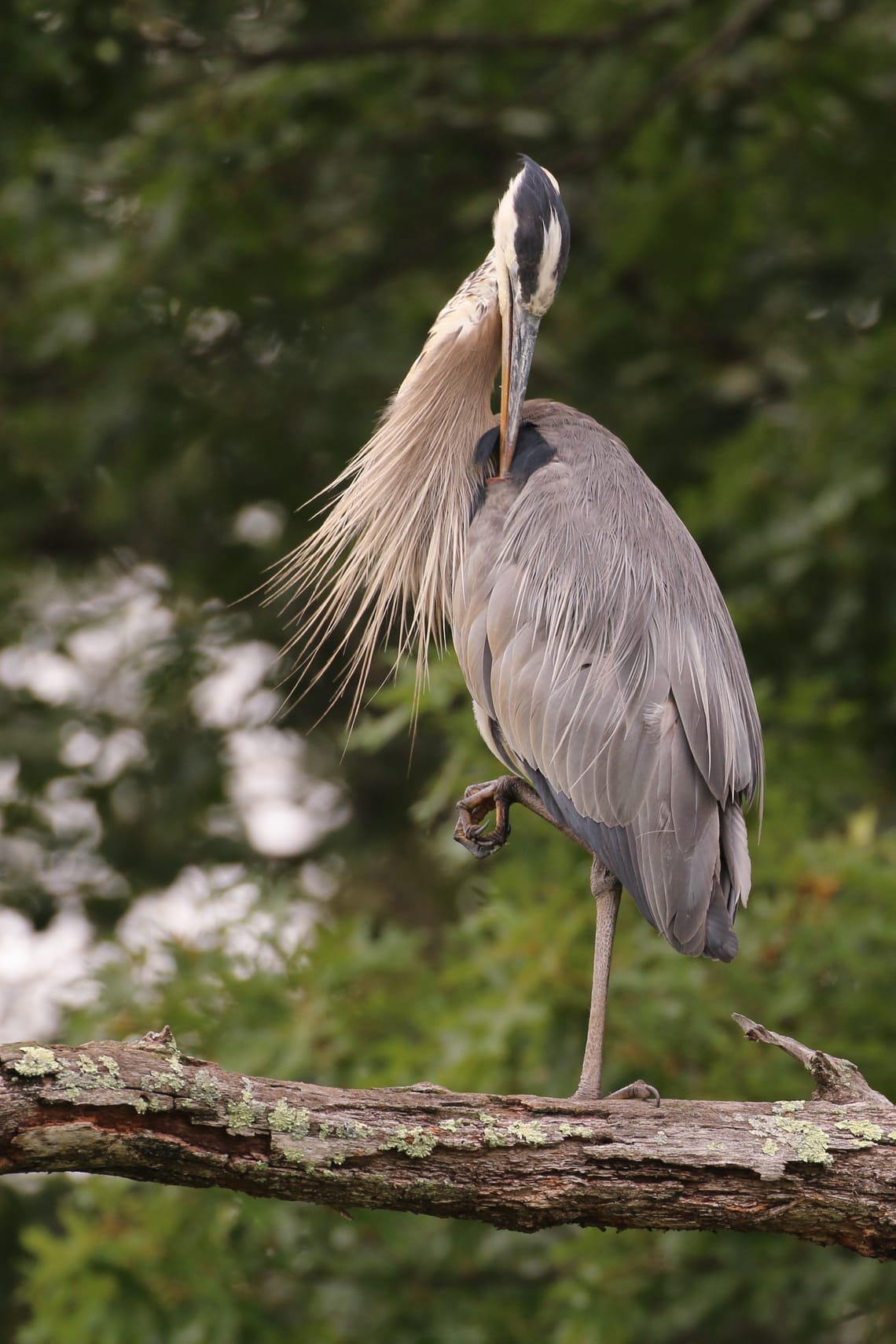
This photograph captures something special - a Great Blue Heron in the midst of its elaborate preening routine. For up to an hour each day, these birds meticulously maintain every one of their feathers, running each through their bill to zip the barbules back together.
Watch a heron preen and you'll notice they can reach most of their body with that flexible neck that strikes with lightning speed at fish. For areas they can't quite reach - like the very top of their heads - they'll carefully use their feet to scratch and arrange those plumes, a surprisingly delicate operation for a bird with such powerful talons.
But here's what's remarkable: Great Blue Herons have special powder down feathers that continuously grow and crumble into a fine powder. They spread this powder throughout their plumage, where it absorbs fish slime and oil, then comb it out with a specialized claw. It's nature's dry cleaning system.
The Secret Social Life
Most people see Great Blue Herons as solitary sentinels, and during hunting, they are. But during breeding season, many of these "loners" transform into social birds, nesting in colonies called rookeries that can contain hundreds of pairs. Others, particularly in areas with less competition, maintain their solitary nature even when nesting.
These rookeries are cities in the treetops - noisy, chaotic places where herons build massive stick nests sometimes 4 feet across. The same birds that stand in silent meditation while hunting become vocal, dramatic creatures during breeding season, with elaborate courtship displays involving sky-pointing, twig-passing ceremonies, and those magnificent plumes erected in full display.
Partners greet each other with elaborate rituals, stretching their necks skyward and clacking their bills. They'll present sticks to each other like gifts, carefully adding each to their growing nest. It's a complete personality change from the stoic hunter we usually encounter.
Dawn, Dusk, and Moonlight
Great Blue Herons are crepuscular - most active during the twilight hours of dawn and dusk when prey is abundant and competition is lower. But their large eyes gather available light exceptionally well, and when conditions allow - particularly on bright moonlit nights - they'll continue hunting in near darkness.
This nocturnal ability gives them access to prey that's unavailable to day-hunting competitors. Night-active fish, emerging crayfish, and unsuspecting amphibians all become targets. It's why you might hear their harsh "frahnk" call at 2 AM - they're not roosting like most birds, they're working the night shift.
The Intelligence Factor
Great Blue Herons are remarkably intelligent hunters, and a rare few have even been documented using tools - dropping insects, feathers, or twigs on the water's surface as bait, then catching the fish that come to investigate. However, this behavior is uncommon. Most herons rely on their proven strategy: perfect stillness and lightning-fast strikes.
They also have excellent memories, returning to productive hunting spots at optimal times. They know when the tide brings fish into certain areas, when irrigation flooding brings out frogs, and when fish runs occur. Individual herons develop hunting territories and techniques refined over years.
Winter Warriors
Unlike many wading birds, Great Blue Herons show remarkable flexibility in their migration patterns. While some populations migrate to warmer climates, many individuals tough out northern winters as long as food remains available. If water stays unfrozen, they adapt their hunting to whatever prey they can find - from voles in snowy fields to fish in small patches of open water.
Their ability to switch between hunting strategies is remarkable. The same bird that delicately plucks minnows from shallows will stand in a field, absolutely still, waiting for a mouse to move. They've been observed catching everything from snakes to small birds to gophers. One was even documented catching and eating a juvenile alligator.
The Communication Network
Those harsh calls that sound prehistoric? They're part of a complex communication system. Great Blue Herons have a diverse vocal repertoire with many distinct calls, each with specific meanings - from the "landing call" that announces their arrival to the "skreh" alarm call that warns of danger.
Young herons in the nest make a persistent "rek-rek-rek" begging call that can be heard from a quarter-mile away. Adults have a softer "gogogo" call they use with their mates. During aggressive encounters, they produce a sound like no other - a deep, guttural "frahnk" that seems to come from the age of dinosaurs.
Living Alongside Giants
Perhaps what's most remarkable about Great Blue Herons is how they've adapted to human presence while maintaining their wild requirements. They still need undisturbed nesting sites - tall trees away from activity or protected wetlands - but they've learned to hunt in suburban parks, golf course ponds, and backyard water features.
They've discovered that docks make excellent hunting platforms, that stocked ponds provide easy meals, and that most humans will watch in awe rather than disturb them. It's a delicate balance - wild enough to maintain their mysterious presence, yet adaptable enough to survive in our changing world.
Want to learn more about observing these remarkable birds? Watch our video guide: